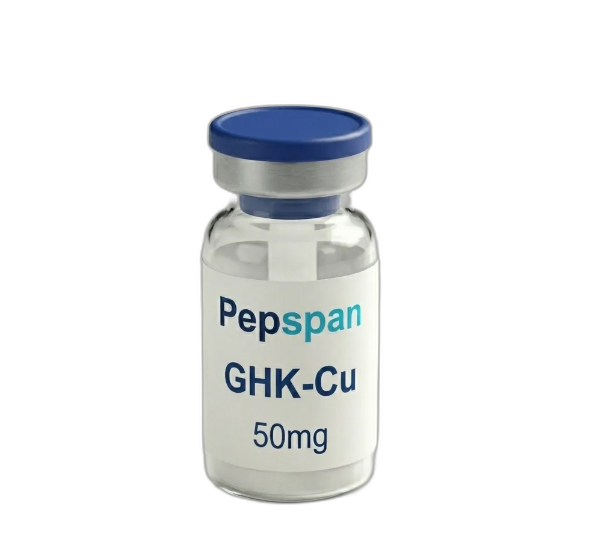
GHK-Cu Copper Peptide 50mg
50mg per vial — Lyophilized Powder
Description
GHK-Cu at a glance. GHK-Cu 50 mg, a lyophilised powder for laboratory research use, costs €59.90 at Pepspan. The current lot, PEP-GHKCU-2607-01, was tested by Janoshik Analytical at 99.8% HPLC purity — verify the report. Ships from Europe with EU delivery in 2–5 days; free shipping on orders over €50. Pay by card, PayPal, SEPA bank transfer (−5%) or crypto (−15%).
GHK-Cu (glycyl-L-histidyl-L-lysine copper(II) complex) is a naturally occurring copper-binding tripeptide first identified in human plasma by Dr. Loren Pickart in 1973. The peptide exists physiologically as a complex with copper(II) ions and is found in saliva, urine, and plasma, where its concentration declines significantly with age. At age 20, plasma GHK-Cu levels average approximately 200 ng/mL, declining to roughly 80 ng/mL by age 60. This age-related decline has made GHK-Cu a focal point of anti-aging and regenerative research, as the peptide appears to function as a systemic signaling molecule involved in tissue maintenance and repair.
The wound healing properties of GHK-Cu have been extensively documented in the scientific literature. In dermal wound models, GHK-Cu treatment accelerates wound contraction, stimulates collagen synthesis (types I and III), and promotes the formation of organized granulation tissue. The mechanism involves attraction of immune cells and mesenchymal stem cells to wound sites, along with stimulation of glycosaminoglycan production and decorin synthesis, both of which are critical for proper extracellular matrix assembly. In vitro studies have demonstrated that GHK-Cu increases the production of metalloproteinases and their inhibitors (TIMPs), enabling coordinated matrix remodeling rather than simply increasing matrix deposition.
Perhaps the most remarkable aspect of GHK-Cu research is its effect on gene expression. Broad Connectivity Map analysis has revealed that GHK-Cu modulates the expression of over 4,000 human genes, representing approximately 6% of the genome. Notably, the peptide upregulates genes associated with tissue repair and regeneration while simultaneously downregulating genes linked to tissue destruction and inflammatory damage. Specific pathways affected include TGF-beta superfamily signaling, Wnt signaling, antioxidant defense (including superoxide dismutase, glutathione S-transferases, and thioredoxin reductase), and DNA repair mechanisms. This genome-wide regulatory activity is unusual for such a small molecule and suggests GHK-Cu functions as a master regulatory switch in tissue homeostasis.
Stem cell research has revealed that GHK-Cu serves as a potent attractor for mesenchymal stem cells and promotes their differentiation into multiple cell lineages. In bone tissue studies, the peptide has been shown to stimulate osteoblast activity and enhance bone formation in experimental fracture models. Hair follicle research has documented that GHK-Cu increases follicle size, stimulates hair growth in organ culture models, and extends the anagen (growth) phase of the hair cycle. Nerve tissue studies have shown that GHK-Cu promotes Schwann cell proliferation and neurotrophin secretion, suggesting relevance to peripheral nerve regeneration research.
The copper component of GHK-Cu is integral to its biological activity. Copper(II) ions serve as essential cofactors for numerous enzymes involved in tissue repair, including lysyl oxidase (collagen cross-linking), cytochrome c oxidase (mitochondrial energy production), and superoxide dismutase (antioxidant defense). GHK-Cu provides a physiological delivery mechanism for copper to these enzyme systems. The peptide is supplied as a blue-tinged lyophilized powder at 50mg per vial, with purity exceeding 98% by HPLC analysis, and includes verified copper content by atomic absorption spectroscopy.
EU Shipping: Ships from Spain to all 27 EU countries. Free shipping on orders over €50. No customs delays — intra-EU shipment. Tracked courier with temperature-aware handling.
Reconstitution & Storage
GHK-Cu 50mg is supplied as a lyophilized powder; in the laboratory it is reconstituted with bacteriostatic water (0.9% benzyl alcohol) under aseptic conditions — swirl gently, do not shake, since vigorous agitation can disrupt the copper coordination chemistry and damage the peptide structure.
- Expected appearance: Clear solution with a characteristic pale blue tint. The blue color is from the copper(II) ion chelated by the GHK ligand — this is normal and confirms intact complex formation.
- Containers: Use copper-free, low-protein-binding polypropylene tubes for aliquoting. Avoid glass for long-term storage of working solutions.
- Post-reconstitution stability: Store at 2-8°C protected from light. Use within 14 days; discard if solution turns brown or develops particulates.
Stability & Half-Life Data
- Plasma half-life: Approximately 30 minutes following systemic administration in rodent pharmacokinetic studies. The short half-life reflects rapid clearance and ligand exchange with serum proteins such as albumin and ceruloplasmin.
- Lyophilized stability: Up to 24 months when stored at -20°C in a sealed vial protected from light and moisture. Up to 4 weeks at 2-8°C without measurable purity loss.
- Reconstituted stability: 14 days at 2-8°C in copper-free polypropylene containers, protected from light. Beyond 14 days, gradual loss of copper coordination and peptide degradation may occur.
- Photodegradation: The copper(II)-peptide complex is photosensitive. Direct UV or strong visible light exposure can cleave the coordination bond. Always store and handle in amber tubes or under low-light conditions.
- Thermal stability: The lyophilized form is stable up to 40°C for short transport excursions. Avoid sustained temperatures above 25°C.
- Freeze-thaw: Avoid repeated freeze-thaw cycles of reconstituted solution. Aliquot into single-use volumes before freezing if long-term storage is required.
- Incompatibilities: Avoid strong reducing agents, EDTA, and high-affinity copper chelators — they will strip the copper from the peptide and abolish biological activity.
Composition
- Peptide: GHK-Cu (Glycyl-Histidyl-Lysine Copper Complex)
- Sequence: Gly-His-Lys-Cu(II)
- Molecular Formula: C14H24CuN6O4
- Molecular Weight: 403.92 g/mol
- Purity: >98% (HPLC)
- Appearance: Blue-tinged lyophilized powder
- Quantity: 50mg per vial
Storage
- Store lyophilized peptide at -20C for long-term storage (up to 24 months).
- For short-term storage (up to 4 weeks), refrigerate at 2-8C.
- After reconstitution, store at 2-8C and use within 14 days.
- Avoid repeated freeze-thaw cycles.
- Protect from light, moisture, and oxidizing agents at all times.
- Use sterile, copper-free containers for reconstituted solutions.
Certificate of Analysis
Every batch of GHK-Cu sold by Pepspan undergoes rigorous third-party testing. Our Certificate of Analysis (COA) reports HPLC purity and the actual content per vial, measured by Janoshik Analytical on each lot. COA documentation is available upon request for any batch number. All testing is performed by independent European laboratories to ensure the highest standards of accuracy and reliability.
Batch Purity Report
Janoshik VerifiedCurrent Batch: Pending first shipment
Every batch of GHK-Cu sold by Pepspan is independently tested by Janoshik Analytical (Prague, Czech Republic). HPLC purity and the actual content per vial are measured for each shipment. Reports are batch-specific — not generic.
View All Purity Reports →Research Disclaimer
This product is intended for laboratory research use only. It is not a drug, food, cosmetic, or dietary supplement. GHK-Cu is not approved for human or veterinary use by any regulatory agency. It must not be administered to humans or animals outside of approved clinical trials. By purchasing this product, you confirm that you are a qualified researcher and that this product will be used exclusively for legitimate scientific research purposes. Pepspan assumes no liability for any misuse of this product. All handling must comply with local regulations and institutional safety protocols.
Frequently Asked Questions
What is GHK-Cu?
GHK-Cu (glycyl-L-histidyl-L-lysine copper(II) complex) is a naturally occurring copper-binding tripeptide first identified in human plasma in 1973. Its physiological concentration declines with age (from ~200 ng/mL at age 20 to ~80 ng/mL at age 60). It is widely studied for collagen synthesis, wound healing, gene expression modulation, and stem cell attraction in research models.
How is GHK-Cu reconstituted?
GHK-Cu 50mg is supplied lyophilised; in the laboratory it is reconstituted with bacteriostatic water under aseptic conditions — swirl gently, do not shake, since vigorous agitation can disrupt the copper coordination chemistry. The solution should be clear with a characteristic light blue tint due to copper(II).
What is the typical research concentration used for GHK-Cu?
Published in vivo studies have used GHK-Cu across a range of concentrations in rodent models. In vitro studies typically use concentrations between 1 nM and 10 μM depending on the cellular endpoint. Researchers should consult primary literature (Pickart et al., 2012; 2015; 2017) for the concentrations reported in each study.
How long is GHK-Cu stable after reconstitution?
Reconstituted GHK-Cu should be stored refrigerated (2-8°C) and used within 14 days. Use copper-free, low-protein-binding containers (polypropylene) to avoid sequestration. Protect from light at all times — the copper complex is photosensitive. Discard if solution turns brown or develops particulates.
Can I buy GHK-Cu in Europe?
Yes. Pepspan ships GHK-Cu 50mg across all 27 EU countries from Spain. Each batch is independently tested by Janoshik Analytical (Prague, Czech Republic) for HPLC purity and content per vial. COA included. Research Use Only. Orders ship from Europe — no customs delays, intra-EU shipment.
Do I need a prescription for GHK-Cu?
Pepspan does not sell medicines and does not dispense against prescriptions. GHK-Cu is supplied exclusively as a reference material for laboratory research, not for human or veterinary use. Check the regulations in your country before ordering.
How does GHK-Cu compare to copper peptides in cosmetics?
Cosmetic copper peptide formulations typically contain GHK-Cu at very low concentrations (0.05-0.2%) in topical bases optimized for skin penetration. Research-grade lyophilized GHK-Cu, by contrast, is a >98% pure peptide reference material with verified copper content, intended for controlled laboratory studies on collagen synthesis, gene expression, and stem cell biology — not for cosmetic application.
Is GHK-Cu tested by Janoshik?
Yes. Every batch of Pepspan GHK-Cu is independently tested by Janoshik Analytical (Prague). The Certificate of Analysis covers HPLC purity and the actual content per vial. COA is batch-specific and available on request.
Where can I buy GHK-Cu online in Europe?
GHK-Cu 50mg (copper peptide, lyophilized vial) is for sale online at Pepspan for €59.90, shipped from our stock in Spain. The current lot PEP-GHKCU-2607-01 was tested by Janoshik Analytical (Prague): 99.8% HPLC purity; the certificate is on /l/GHKCU2607. Orders leave Spain within 24–48 h with tracking; delivery in the EU usually takes 2–5 business days. Free EU shipping on orders over €50; GB, CH, NO, IS and LI ship at a flat €19.90; UK orders usually arrive 2–3 business days after dispatch (UPS, tracked). Pay by card, PayPal, bank transfer or crypto. Research use only.
Further Research Resources
Additional research articles, comparison guides, and laboratory protocols related to this peptide:
Related Products
 BEST VALUE